
From cause to plan, when you define it.
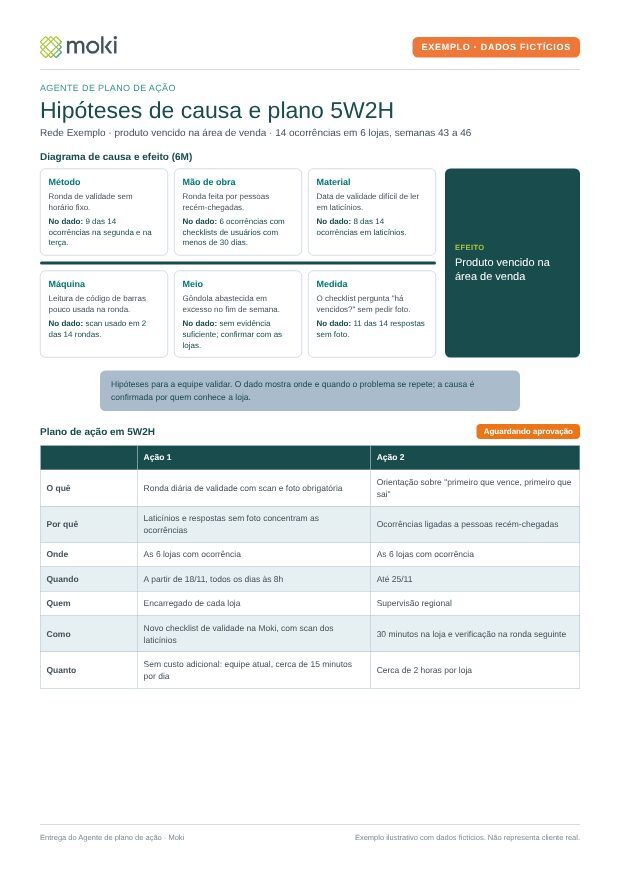
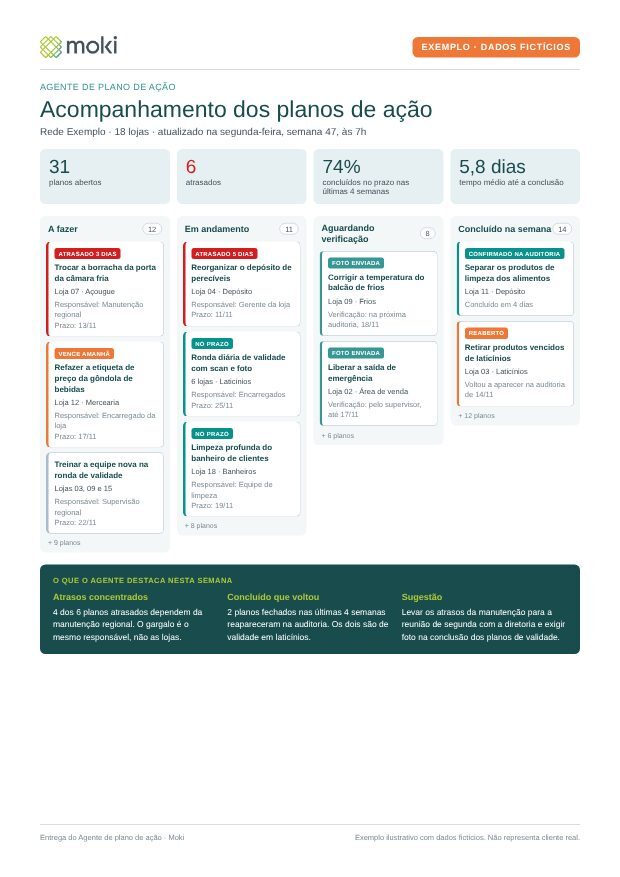
In the situations you define, the agent analyzes the cause of the non-conformity, writes the plan with owner and deadline and sends it for approval. In the others, your team writes it. Then it tracks the deadline and alerts you when it's late.
The non-conformity is recorded. The plan never comes.
The manager gets dozens of occurrences a week. Writing plan after plan doesn't fit in the schedule. The same problem comes back on the next visit.
Every plan waiting to be written is a problem still in the store.
A complete plan, not just a reminder.
Based on the history of the unit and the item.
What, why, where, when, who, how and how much.
Suggested by the agent, decided by the manager.
Reminders before and after they're due.
The writing moves to the agent.
| Step | Today | With the agent |
|---|---|---|
| Writing the plan | The manager writes them one by one, when there's time | Plan proposed in the situations you define |
| Finding the cause | Guesswork | Likely cause based on history |
| Chasing the deadline | Someone remembers, or not | Automatic alert to the owner |
| Seeing what repeats | Nobody cross-checks | Recurrence flagged by unit and item |
From occurrence to completed plan.
About the action plan agent
How do I turn this agent on?
The Moki team configures the agent with you: what it reads, when it runs, who receives it and the credit limit.
Is the plan applied without approval?
No. Every plan proposed by the agent goes through a manager's approval.
Does it use a method?
Yes. The default is 5W2H. If your company uses another model, the agent follows yours.
When does the agent kick in?
When a non-conformity is recorded and when a plan is due.
A simple calculation to take to the leadership team: hours spent consolidating, recurrence and the time between the record and the decision.
Bring your open non-conformities.
We show you the plans the agent would write for them.
A specialist will contact you to arrange sending the data through a secure link.
- We bring data from any system, even spreadsheets.
- The reading is done with your operation's numbers.
- Your data is yours. We don't use it to train anyone's AI.